
Agent finance starts here.
Your agents receive a verified on-chain identity, a programmable smart account with one address across all EVM chains, and a spending policy engine that evaluates every transaction in under 10ms.
Your key provider signs. Oris never holds funds.
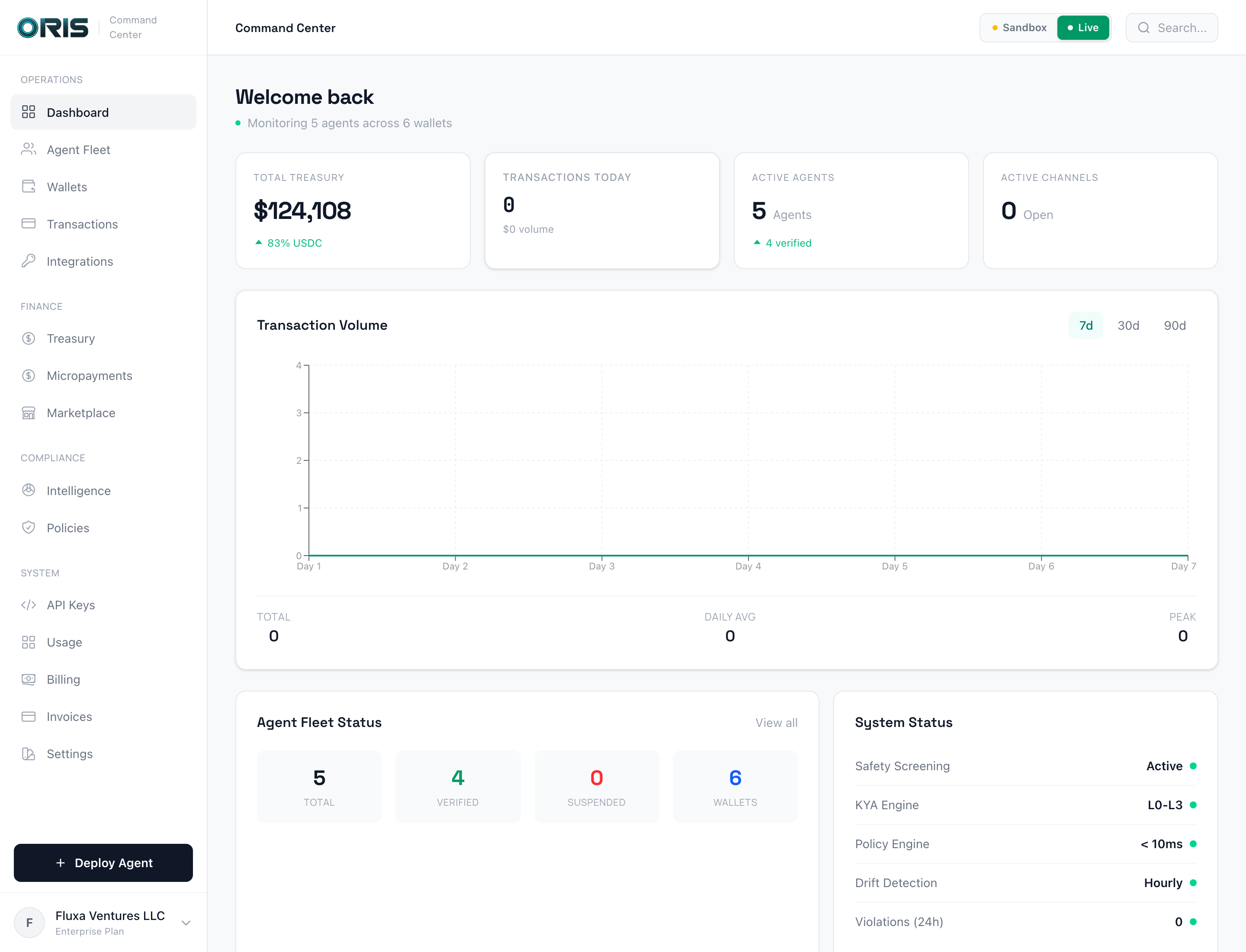
Three things every agent gets.
Verified Identity
On-chain credential on EAS. Any counterparty verifies directly from the blockchain.
Smart Account Wallet
One address across 8 EVM chains. Solana and Tron with native wallets. Rules enforced in the contract.
Programmable Policies
Per-transaction caps, whitelists, and human approval triggers. Fail-closed.
Your agents hold USDC.
The merchant wants a credit card.
Oris converts on-chain stablecoin liquidity into scoped virtual cards, enforces spending rules per agent, and reconciles both ledgers automatically. Your DevOps agent pays for cloud, APIs, and SaaS subscriptions the same way any human team would.
Bridge
Connect Stripe, fund the fiat pool with a bank transfer, and issue each agent a virtual Visa card backed by the pool. One deposit enables autonomous spending across all agents.
Control
Per-agent Visa cards with spending caps, daily limits, and merchant category restrictions. The policy engine evaluates every authorization against Redis-cached rules before Stripe processes it.
Settle
Mirror Settlement runs automatically. When a card charge clears, Oris transfers the equivalent USDC from the agent wallet to the company treasury on-chain. Both pools rebalance atomically.
From zero to authorized card charge in under 90 seconds.
Deploy agent, fund the fiat pool, deposit USDC on-chain, issue a virtual card, set a spending policy, then simulate a merchant authorization. The pipeline evaluates KYA, policy, on-chain balance, and compliance before Stripe clears the charge.
One agent. One address. Every chain.
Oris registers the agent once. After that, the identity is on-chain and the wallet rules are in the contract. Neither requires Oris to keep running.
Agent Identity
Your agent's credentials live on the blockchain, not in our database.
Smart Account Wallet
Same address on Base, Arbitrum, Ethereum, and five more.
Oris tracks agent behavior on a hourly cycle, scores it against five risk signals, and writes the trust level to the Ethereum Attestation Service.
Each transaction updates the agent's behavioral profile. Every 15 minutes, the scoring engine processes payment patterns, counterparty history, and cross-chain activity into a calibrated trust score. Any protocol reads that score directly from the chain without calling the Oris API.
Monitor
Every transaction builds the profile.
The KYA engine records every payment, counterparty address, chain selection, and timestamp across every chain the agent touches. Behavioral patterns accumulate across the full transaction history. A hourly cycle compares recent activity against the agent's established baseline and routes deviations to the scoring pipeline.
Embed
768 dimensions capture every behavioral signal.
Each payment is encoded as a 768-dimension behavioral vector covering counterparty patterns, temporal distribution, amount profiles, and chain preferences. Vectors accumulate across the agent's full transaction history. The distance between the current vector and the historical baseline measures behavioral stability. An agent operating under changed instructions will diverge from its own profile within a small number of transactions.
Score
Five signals. One calibrated score.
Five signals feed the risk score: behavioral drift from the agent's baseline, cross-chain address taint screening, counterparty exposure, velocity deviation, and anomaly trajectory. The output is a calibrated probability between 0 and 1. Scores above the configured threshold block the transaction at evaluation.
Gate
Capacity grows with proven behavior.
An agent starts at L0 with restricted transaction access. Each level requires behavioral proof accumulated over time. L2 requires a clean cross-chain address screening result. L3 requires 30 consecutive days of a stable behavioral baseline. A developer cannot configure an agent to a higher level. The agent earns its level through demonstrated transaction history.
Attest
Published on-chain. Readable by anyone.
When an agent reaches a KYA level, Oris writes the attestation to the Ethereum Attestation Service on Base and Ethereum. Any protocol, bridge, or counterparty reads the trust status directly from the chain without an Oris API call. If Oris goes offline, the attestation remains valid and readable.
Zero to transaction in three steps.
api_key="oris_sk_..."
)
Register your Turnkey, Fireblocks, or Circle keys through envelope-encrypted Vault storage. Your credentials never leave your control. Oris orchestrates. You own the keys.
max_daily=500,
max_per_tx=50
)
Define spending caps, counterparty whitelists, and escalation triggers. The policy engine evaluates every transaction in under 10ms. Your agents move fast. The rules move faster.
to="0x7f3a...",
amount=12.50
)
One call handles chain selection, gas abstraction, and settlement. Payments execute through your own provider account. Oris routes, verifies, and logs. You keep full custody.
Oris provisions and orchestrates. Your key provider signs.
Oris never holds private keys or custody of funds. You connect your existing Turnkey, Fireblocks, or Circle account. Every transaction is signed by your provider. Oris routes, verifies, and logs.
Distributed key management with MPC signing. Connect via API key.
Institutional-grade MPC custody. Full policy engine compatibility.
Programmable wallets with USDC-native settlement.
Six pillars powering the agent economy.
Programmable Guardrails
Per-transaction caps, daily ceilings, counterparty whitelists, and human escalation triggers are defined in a policy file and evaluated against every transaction in under 10ms from an in-memory cache. Every rule fails closed. A transaction that cannot be evaluated is rejected.
Every transaction passes compliance screening before execution.
Every agent payment passes counterparty verification, risk scoring, and behavioral analysis before funds move. The compliance layer runs on Veris, a Fluxa Ventures LLC product built for cross-chain transaction intelligence. Oris and Veris share infrastructure, which keeps the full screening pipeline under 100ms rather than routing through an external API call.
Learn about VerisThree ways teams deploy Oris today.
AI Agent Fleets
Deploy hundreds of agents with centralized spending control. Per-agent budgets, fleet-wide policy enforcement, and real-time visibility from a single dashboard.
Learn MoreAgent-to-Agent Commerce
Agents discover, hire, and pay each other for services through the Oris marketplace. SLA tracking, payment settlement, and dispute resolution run without human coordination.
Learn MoreAutonomous API Consumption
Agents purchasing compute, data, and API access at sub-cent rates. Micropayment channels settle thousands of transactions per second with zero gas overhead.
Learn MoreStart building in 5 minutes.
Install the SDK, register an agent, set a spending policy, and execute a payment. Four function calls from zero to settlement.
Ready to give your agents financial autonomy?
Three lines of code. Full economic autonomy for your AI agents across 10 blockchains.